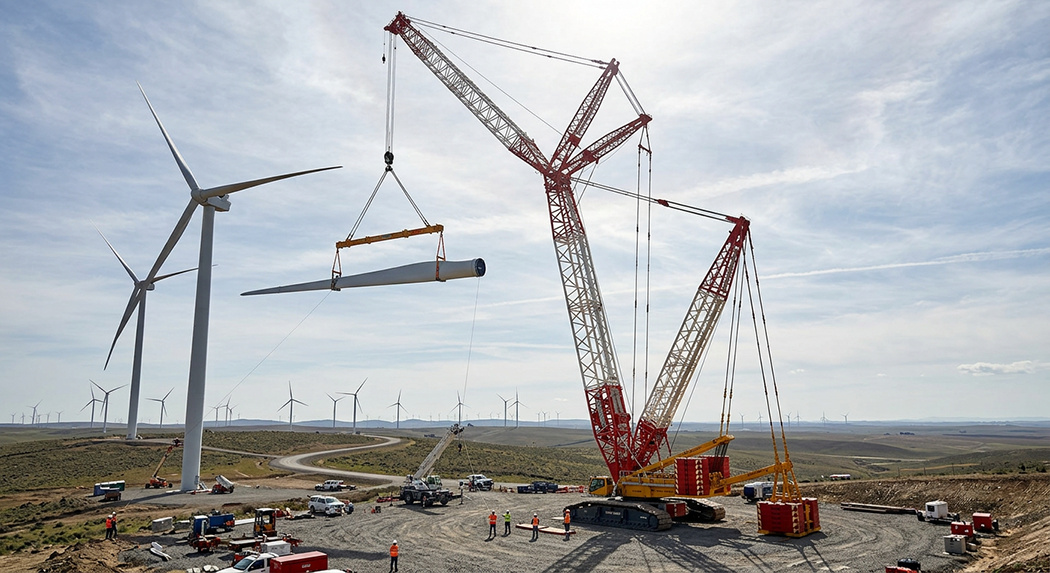
The only constant in lifting is gravity. Almost everything else is changing. Cranes are being designed to handle heavier loads, customers expect longer service life, and operators want greater control over the load, yet there is limited appetite for larger drums, heavier reeving systems or substantially thicker ropes.
That tension is shaping the direction of wire rope development. The industry is being asked to produce more strength and performance from a restricted diameter, but strength alone is not a useful measure of progress. A rope that achieves an impressive breaking load but sacrifices fatigue resistance, crush resistance or predictable handling will not deliver what a crane owner needs in service.
The real challenge is therefore one of balance. Manufacturers must increase the amount of useful performance within the rope while ensuring that it remains durable, inspectable and suited to the machinery on which it will operate.
Strength begins with the wire
A higher-strength rope starts with higher-strength wire, but pushing steel toward its tensile limit introduces risks. As strength rises, the wire can become less tolerant of repeated bending and more vulnerable to brittle behavior. The development process must therefore preserve enough ductility and fatigue resistance for the rope to survive thousands of operating cycles.
This places renewed emphasis on the earliest stages of production. The quality and consistency of the steel rod, the way the wire is drawn, and the control of annealing and heat treatment all influence how the finished rope will perform. Variations that might have been manageable in a general-purpose product become far more significant when producing small-diameter wire for a high-strength, rotation-resistant construction.
Clean, consistent steel is particularly important. Every subsequent operation depends on the quality of that starting material. If the rod contains excessive impurities or varies from one batch to another, it becomes harder to draw fine wire with the repeatable mechanical properties needed for demanding crane ropes. Strong supplier relationships, disciplined incoming inspection and closely controlled mill processes are therefore part ofproduct development, not simply procurement or production concerns.
That is why advances in rope performance cannot be separated from advances in metallurgy and process control. The rope may be the component visible on the crane, but its behavior has already been largely determined by decisions made before the wires are stranded and closed.
Construction is evolving alongside the wire itself. The market is moving beyond traditional six-strand, non-compacted ropes as customers seek greater metallic area within the same overall diameter. Eight-strand and compacted constructions can provide higher strength and improved resistance to wear and crushing, but they also require tightermanufacturing control if those benefits are to be delivered consistently.
The same pressure is driving wider use of Category One rotation-resistant ropes. These were once associated mainly with long-fall applications where controlling load rotation was essential. They are now being specified for shorter falls and duties that would previously have used a more conventional six-strand rope. Load stability is becoming an expectation acrossa broader range of lifts rather than a requirement reserved for the mostdemanding applications.
Different cranes place different demands on the rope
The search for higher performance does not mean the industry is moving toward a single high-specification rope for every crane. The opposite is true. As cranes and lifting duties become more demanding, rope selection is becoming more closely tied to the application.
A lattice boom crane may carry a considerable length of rope and rely on multilayer spooling. The rope must withstand pressure from the layers above it without flattening or losing its structural integrity. A rough terrain crane may operate with fewer layers, but still require high strength, rotation resistance, corrosion resistance, inspectability and reliable handling in an outdoor environment.
Overhead cranes introduce another set of demands. Although industry attention often falls on large mobile and lattice boom cranes, overhead cranes represent a substantial part of the North American market. Steel mills in particular are moving away from general-purpose ropes as they seek better performance under high temperatures, repetitive duty and severe operating conditions.
These applications are encouraging manufacturers to look beyond the rope's steel construction and examine how lubrication performs under heat. Lubrication protects against corrosion and allows wires and strands to move against one another as the rope bends. If it breaks down or changes consistency at elevated temperatures, internal wear can accelerate even when the rope appears satisfactory from the outside. Research into lubricant performance must therefore accompany metallurgical development for high-temperature duties.
Corrosion protection is becoming more important for similar reasons. Many crane ropes are removed because they have suffered external damage or corrosion rather than because they have reached their theoretical fatigue life. That has strengthened the case for galvanized ropes in applications where the rope will spend most of its working life exposed to weather.
Galvanized running ropes were once viewed cautiously because of concerns that the zinc coating could affect flexibility or bending performance. Improvements in production and growing field experience have reduced those concerns. The question is increasingly not whether galvanizing belongs on a hoist rope, but whether an unprotected rope makes sense when corrosion is likely to determine its service life.
Synthetic rope has not displaced steel in the mobile crane market to the extent once anticipated. It has established a strong position in lifting slings and selected marine applications, where low weight and corrosion resistance provide clear benefits. For running ropes on mobile cranes, however,steel continues to offer a combination of durability, inspectability and familiar handling that remains difficult to replace. Synthetic rope has foundapplications in which its advantages clearly outweigh sensitivities to heat,ultraviolet exposure and external damage, rather than becoming a universalsubstitute for steel.
Consistency and lifecycle value
Most wire ropes begin with the same broad sequence: steel rod is drawn into wire, wires are formed into strands, and strands are closed into rope. What differentiates a dependable high-performance product is the consistency achieved at every stage. Reliable raw materials, controlled drawing and closing processes, disciplined quality systems and repeatable inspectionall become more important as wire diameters decrease and tensile requirementsrise.
Standards provide the framework within which that performance must be delivered. In North America, the ASME B30 volumes address crane and lifting requirements, while ASTM standards support the manufacture and testing of wire rope and its constituent materials. Meeting the applicable standard is essential, but it is not the end-point of development. A rope must also perform predictably on the intended crane, drum and sheave system, under the environment and duty cycle for which it was selected.
That distinction matters when comparing purchase price. Availability and lead time will always influence a buying decision, but the lowest initial price does not automatically produce the lowest cost peroperating hour. Service life, resistance to corrosion and damage, installation behavior, inspection requirements and the operational consequences of premature replacement all contribute to lifecycle value. Crane owners should compareropes on the performance required for the application rather than treatingproducts of the same nominal diameter as interchangeable.
Development must prove itself on the crane
As ropes become more specialized, laboratory testing becomes more important, but it cannot provide the full answer. Manufacturers can examine individual wires, analyze strand behavior and compare fatigue performance between rope constructions. Those tests reveal whether a design has the strength and durability required to move forward, but they cannot reproduceevery interaction between the rope, drum, sheaves and crane controls.
New products therefore need to move from controlled testing into carefully selected field trials. OEM test pads provide one route, while repetitive lifting duties can offer another. Applications such as steel erection or tilt-up construction allow the rope to perform similar lifts repeatedly, making changes in spooling, handling and surface condition easier to observe.
Feedback from experienced operators is particularly valuable because they recognize how a rope should feel and behave on a particular crane. They can identify uneven spooling, changes in control response or installation difficulties that may not appear in laboratory data. Manufacturers also need candid reports when a prototype does not perform as expected. Negative feedbackcan expose an installation issue, a mismatch between construction andapplication, or a feature that needs further refinement.
The most effective development process is therefore a feedback loop. Laboratory analysis identifies promising constructions, controlled fatigue testing compares performance, field trials reveal how the rope interacts with the complete crane system, and operator observations guide the next design adjustment. This approach takes more coordination than relying on a breaking-strength figure alone, but it reduces the risk of optimizing one property at the expense of another.
The next generation of wire ropes will not be defined by tensile strength alone. Progress will come from combining cleaner steel, more controlled wire production, application-specific construction and more realistic testing. The objective is not simply to produce a stronger rope, but to deliver that strength without losing the fatigue life, handling, inspectability and reliability on which every lift depends.